Politics and Sports
Lance Armstrong doping case

The scandal involving Lance Armstrong is one of the most infamous in sports history. Armstrong won seven consecutive Tour de France titles between 1999 and 2005, becoming a global symbol of resilience after surviving testicular cancer. For years, he denied allegations that he used performance-enhancing drugs.
In 2012, the United States Anti-Doping Agency (USADA) released a detailed report accusing Armstrong of leading a sophisticated and long-running doping program. The evidence included testimony from former teammates, financial records, and biological data. Substances such as EPO, testosterone, blood transfusions, and masking agents were reportedly used.
As a result, Armstrong was stripped of all his Tour de France titles and banned for life from professional cycling. Sponsors dropped him, and his public image collapsed. In 2013, he admitted to doping in a televised interview with Oprah Winfrey, ending years of denial.
The scandal had a profound impact on cycling, exposing systemic doping and leading to stricter anti-doping controls. Armstrong’s case remains a cautionary tale about fame, pressure, and the cost of cheating in elite sports.
The Influence of Sponsors in the NBA: From Michael Jordan to the 2024 Olymic
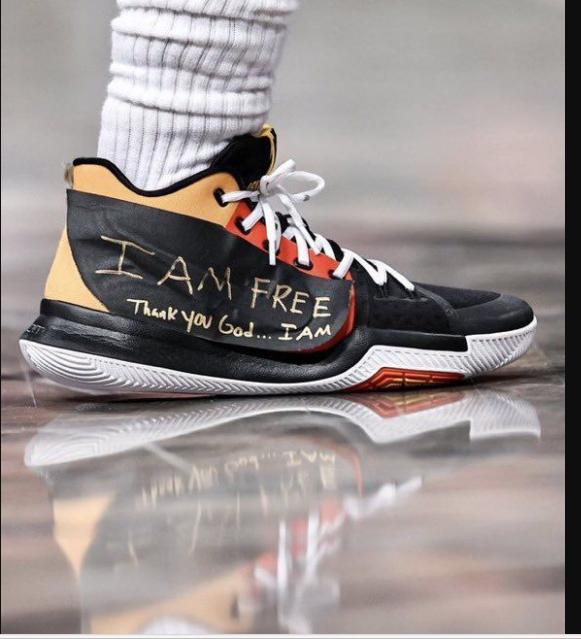
Sponsorships play a major role in the NBA, shaping players’ careers, the league’s image, and sometimes public debate. Over the years, relationships between athletes and major brands have shown how business interests can influence the world of professional basketball.
One of the most famous examples dates back to the 1980s with Michael Jordan. When Nike released the first Air Jordan sneakers, the NBA considered them illegal because they did not respect uniform rules (the shoe was not white enough). As a result, Jordan was fined every time he wore them during games. Nike chose to pay these fines, turning the situation into a powerful marketing strategy. The story of the “banned” shoes helped make Air Jordan a global success and changed how athletes and sponsors worked together.
Today, Nike remains the official outfitter of the NBA, confirming its strong influence within the league. However, sponsorships can also become a source of tension. Kyrie Irving, who had one of Nike’s most successful signature shoe lines, saw his partnership with the brand end in 2022 following controversial statements on social media. Nike decided to suspend and later terminate the deal, officially distancing itself from the player.
In 2024, Irving was not selected for the U.S. basketball team at the Paris Olympic Games. While the official explanation focused on team balance and sporting choices, the decision led to public discussion. Some commentators questioned whether Irving’s damaged relationship with Nike (a key partner of USA Basketball) may have influenced perceptions. Although there is no proof of direct sponsor involvement, the debate highlights how closely business, image, and sport are connected in modern basketball.
Qatar 2022: A World Cup Surrounded by Corruption Allegations

The 2022 FIFA World Cup in Qatar was one of the most controversial sporting events in history. From the moment Qatar was chosen as the host country in 2010, suspicions of corruption have followed the competition and damaged its image.
Several investigations have suggested that members of FIFA may have accepted bribes in exchange for their votes. Journalists and former officials revealed that large sums of money and political influence could have played a role in Qatar’s selection, despite the country’s lack of football tradition and extreme climate conditions. These revelations raised serious questions about transparency and fairness within international sports institutions.
Beyond corruption allegations, the World Cup was also criticized for human rights issues. Thousands of migrant workers were involved in building stadiums and infrastructure, often working in dangerous conditions. Many reports denounced poor working conditions, low wages, and a high number of deaths, which increased public outrage and reinforced the idea that economic interests were prioritized over human lives.
FIFA denied any wrongdoing and claimed that the tournament brought positive changes to Qatar, such as labor reforms and international visibility. However, for many fans and experts, these arguments were not enough to erase the doubts. The credibility of FIFA was deeply affected, and many people questioned whether sport was still guided by ethical values.